About us
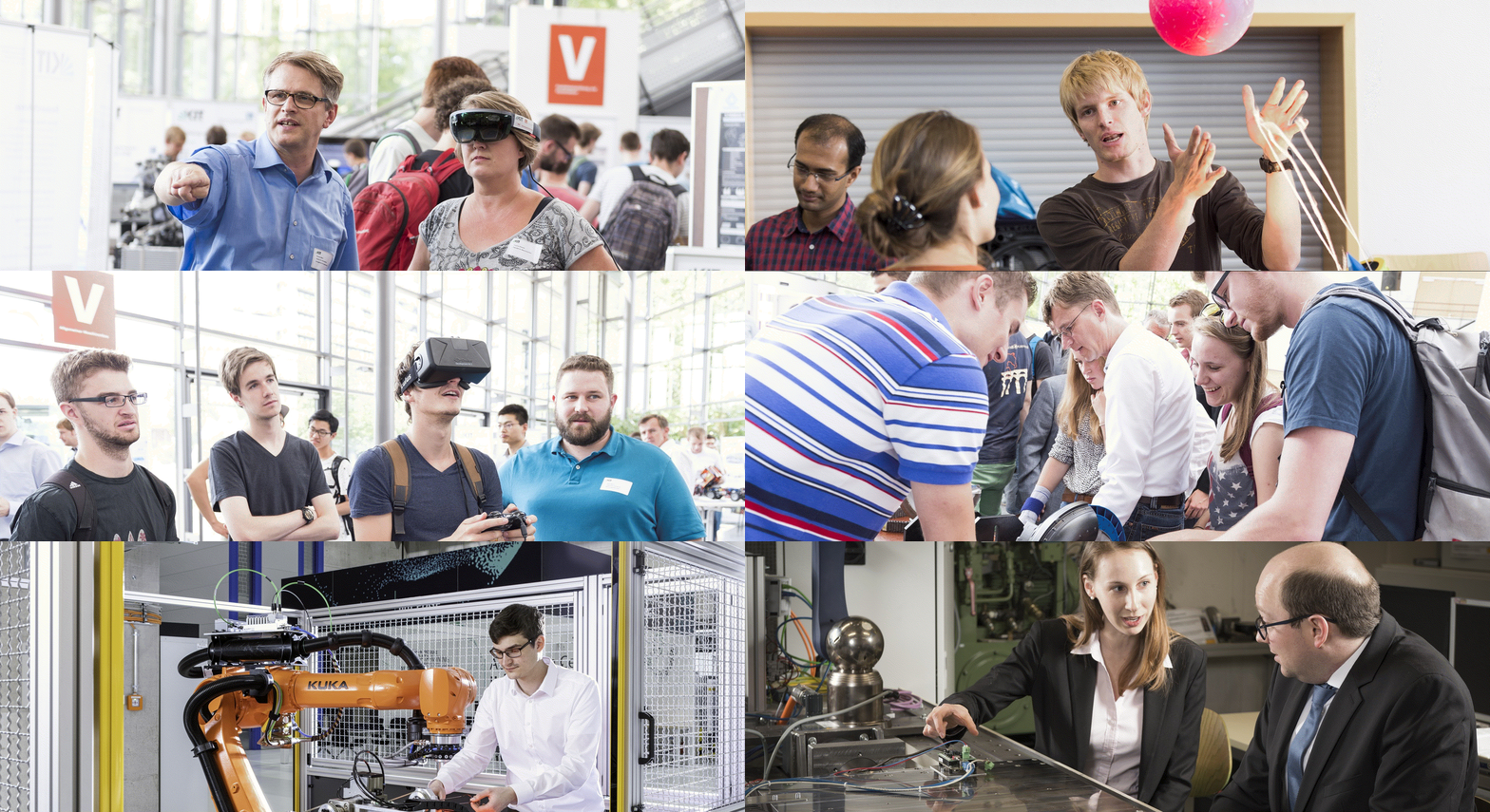
The Department of Mechanical Engineering is part of KIT's Area 3 "Mechanical and Electrical Engineering" together with the Department of Electrical Engineering and Information Technology, four Helmholtz programs, and eight institutes of the large-scale research area. The department consists of more than 20 institutes with about 1,000 employees, including about 45 professors, 460 scientific employees, and 200 employees in administration and technology. In addition, there are several hundred tutors and scientific assistants.


Professor Peter Gumsch of the Institute for Applied Materials – Reliability and Microstructure (IAM-ZM) is celebrating his 25th anniversary of service. Our photo shows him at the certificate presentation on October 2, 2026, with Professor Christoph Stiller, Dean of the KIT Department of Mechanical Engineering. The department extends its warmest congratulations to Professor Gumsch.

The AK-X flying-wing glider, developed by the Academic Flying Group (Akaflieg), successfully completed its maiden flight at Giebelstadt Airfield. What makes it unique: As a flying-wing aircraft, the AK-X dispenses with a long fuselage and a conventional tail unit, significantly reducing drag and boosting flight performance. More than 100 students developed and built the aircraft on a voluntary basis alongside their studies over a period of more than 15 years. In the flight testing phase that follows, they are now investigating how the tail-less design affects flight behavior and performance. In doing so, they are gathering scientific insights into the flight mechanics of this tail-less concept.
Source: KIT-Instagram

“KA-RaceIng e.V.” is a student group founded in 2006 at the Karlsruhe Institute of Technology that participates in one of the largest international engineering competitions, Formula Student. In Formula Student, students design and build their own race cars. With the conclusion of Formula Student Germany at the Hockenheimring, an eventful and exciting 2026 season ends, during which the team delivered impressive performances on Europe’s racetracks, both with the KIT26e and the hydrogen-powered KIT26h.
Source: KA-RaceIng, September Newsletter

Two early-career researchers from Karlsruhe Institute of Technology (KIT) have been successful in the latest call for Starting Grants from the European Research Council (ERC): In the COOLWEAVE project, Dr. Jingyuan Xu is developing a climate-friendly cooling technology. In the DATAARK project, Dr. Maryia Rusak is investigating how a classification system for building information developed across Europe after the Second World War and influenced major architectural projects. The two five-year projects will each receive EUR 1.5 million in funding.

After a weak start to the year, the East German machinery and plant engineering sector recorded significantly more orders in the second quarter of 2026, though many customers remain reluctant to invest. In the second quarter of 2026, order intake in the East German machinery and plant engineering sector was 27 % higher in real terms than in the same period of the previous year. Domestic business grew by 19 %, while foreign orders rose by 30 %. Demand from the eurozone showed particularly strong growth, up 55 %, while orders from non-eurozone countries rose by 20 %.

The “First International Roughness Workshop 2026” at KIT, organized by the Institute of Fluid Mechanics (ISTM), took place from July 26 to 27, 2026, focusing on the question of how roughness in turbulent flows can be better compared and standardized. The workshop covered experiments, simulations, and modeling, the handling of uncertainties, as well as requirements for a common reference roughness and relevant metadata. In addition to the technical exchange, the workshop also provided opportunities for networking and establishing new international collaborations.
more News